Uwe Hesse

Dieser Benutzer hat keine biographischen Informationen freigegeben
Startseite: http://uhesse.com
New mean demo machine
Veröffentlicht in TOI am Dezember 8, 2016
My new Notebook is there! Will spend a couple of hours to do the setup. The specs are quite promising:
CPU:
Intel Core i7-6700 | 4 Cores | 8 Threads | 3,4 – 4,0GHz
Memory:
32GB SO-DIMM DDR4 RAM 2400MHz Crucial Ballistix Sport LT
6 TB SSD Storage:
1TB m.2 Crucial MX300
1TB m.2 Crucial MX300
2TB Seagate FireCuda | 5400U/Min | 7mm
2TB Seagate FireCuda | 5400U/Min | 7mm
Okay it did cost me a fortune. See the new one on the left:

But that baby should allow for two 2-Node Clusters running with Virtualbox VMs plus a Cloud Control VM. Want to have my own Maximum Availability lab – and it’s still less expensive and easier to transport than an Oracle Database Appliance 😉
#ukoug_tech16 Review with Tweets
Veröffentlicht in TOI am Dezember 7, 2016
UKOUG Tech16 is in its final hours, time for a special review: Tweets about it
It was in Birmingham again – very nice location!
Birmingham! #ukoug_tech16 pic.twitter.com/mBeFL82MJf
— Kamil Stawiarski (@ora600pl) December 5, 2016
//platform.twitter.com/widgets.js
Standard Edition attracts not only my attention more and more
Attending Johannes Ahrends talking about Why not Standard Edition at #ukoug_tech16 cc/@carajandb pic.twitter.com/25A21BKHL0
— Uwe Hesse (@UweHesse) December 5, 2016
//platform.twitter.com/widgets.js
We have had a well visited Round Table about Standard Edition
Join us for the Standard Edition Round Table at 13:10 Hall 1 Foyer Level 5 #ukoug_tech16 pic.twitter.com/2xQFD4PRUU
— Uwe Hesse (@UweHesse) December 5, 2016
//platform.twitter.com/widgets.js
and one about Data Guard as well
Join us for the Data Guard Round Table at 14:10 in Hall 1 Foyer Level 5 #ukoug_tech16 pic.twitter.com/c5XM6woU4d
— Uwe Hesse (@UweHesse) December 5, 2016
//platform.twitter.com/widgets.js
Many top-notch speakers again
Attending Andy Colvin talking about Quick Tips for Exadata #ukoug_tech16 pic.twitter.com/WDG9VwtwXa
— Uwe Hesse (@UweHesse) December 5, 2016
//platform.twitter.com/widgets.js
Attending @Chrisantognini talking about Performance Analysis without Diagnostics Pack #ukoug_tech16 pic.twitter.com/MtFPkMzTVy
— Uwe Hesse (@UweHesse) December 6, 2016
//platform.twitter.com/widgets.js
Attending @oracleracpm talking about Extended RAC New Features #ukoug_tech16 pic.twitter.com/6dT0qXkHwC
— Uwe Hesse (@UweHesse) December 6, 2016
//platform.twitter.com/widgets.js
(Sorry, forgot to take a pic here)
Attending Jason Arneil talking about Exadata patching #ukoug_tech16
— Uwe Hesse (@UweHesse) December 6, 2016
//platform.twitter.com/widgets.js
Attending Mike Dietrich talking about Upgrade (What else?) Strategies #ukoug_tech16 pic.twitter.com/4gGWO7bz97
— Uwe Hesse (@UweHesse) December 7, 2016
//platform.twitter.com/widgets.js
Attending Oyvind Isene talking about Hadoop for DBAs #ukoug_tech16 pic.twitter.com/WEUETWYjnJ
— Uwe Hesse (@UweHesse) December 7, 2016
//platform.twitter.com/widgets.js
I did my part and delivered two talks also: One about what changes with Multitenant for the DBA like I did at the DOAG conference and one about what can be done with Partitioning since 8i. Both talks were well received by a friendly crowd, thank you for that 🙂 As always, it was a nice experience and I’d like to express my appreciation to the organizers of this great event!
How to reduce Buffer Busy Waits with Hash Partitioned Tables in #Oracle
Veröffentlicht in TOI am Dezember 6, 2016

Large OLTP sites may suffer from Buffer Busy Waits. Hash Partitioning is one way to reduce it on both, Indexes and Tables. My last post demonstrated that for Indexes, now let’s see how it looks like with Tables. Initially there is a normal table that is not yet hash partitioned. If many sessions do insert now simultaneously, the problem shows:
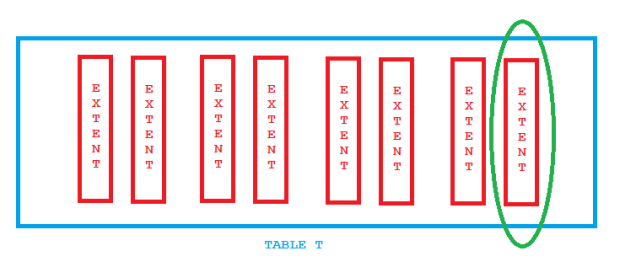
Contention with a heap table
The last extent becomes a hot spot; all inserts go there and only a limited number of blocks is available. Therefore we will see Buffer Busy Waits. The playground:
SQL> create table t (id number, sometext varchar2(50));

Table created.

create sequence id_seq;

Sequence created.

create or replace procedure manyinserts as
begin
 for i in 1..10000 loop
  insert into t values (id_seq.nextval, 'DOES THIS CAUSE BUFFER BUSY WAITS?');
 end loop;
 commit;
end;
/

Procedure created.

create or replace procedure manysessions as
v_jobno number:=0;
begin
FOR i in 1..100 LOOP
 dbms_job.submit(v_jobno,'manyinserts;', sysdate);
END LOOP;
commit;
end;
/

Procedure created.
The procedure manysessions is the way how I simulate OLTP end user activity on my demo system. Calling it leads to 100 job sessions. Each does 10.000 inserts:
SQL> exec manysessions

PL/SQL procedure successfully completed.

SQL> select count(*) from t;

  COUNT(*)
----------
   1000000

SQL> select object_name,subobject_name,value from v$segment_statistics
     where owner='ADAM'
     and statistic_name='buffer busy waits'
     and object_name = 'T';

OBJECT_NAM SUBOBJECT_	   VALUE
---------- ---------- ----------
T			    2985
So we got thousands of Buffer Busy Waits that way. Now the remedy:
SQL> drop table t purge;

Table dropped.

SQL> create table t (id number, sometext varchar2(50))
     partition by hash (id) partitions 32;

Table created.


SQL> alter procedure manyinserts compile;

Procedure altered.

SQL> alter procedure manysessions compile;

Procedure altered.

SQL> exec manysessions

PL/SQL procedure successfully completed.

SQL> select count(*) from t;

  COUNT(*)
----------
   1000000

SQL> select object_name,subobject_name,value from v$segment_statistics
     where owner='ADAM'
     and statistic_name='buffer busy waits'
     and object_name = 'T';

OBJECT_NAM SUBOBJECT_	   VALUE
---------- ---------- ----------
T	   SYS_P249	       0
T	   SYS_P250	       1
T	   SYS_P251	       0
T	   SYS_P252	       0
T	   SYS_P253	       0
T	   SYS_P254	       0
T	   SYS_P255	       0
T	   SYS_P256	       1
T	   SYS_P257	       0
T	   SYS_P258	       0
T	   SYS_P259	       1
T	   SYS_P260	       0
T	   SYS_P261	       0
T	   SYS_P262	       0
T	   SYS_P263	       0
T	   SYS_P264	       1
T	   SYS_P265	       1
T	   SYS_P266	       0
T	   SYS_P267	       0
T	   SYS_P268	       0
T	   SYS_P269	       0
T	   SYS_P270	       0
T	   SYS_P271	       1
T	   SYS_P272	       0
T	   SYS_P273	       0
T	   SYS_P274	       0
T	   SYS_P275	       1
T	   SYS_P276	       0
T	   SYS_P277	       0
T	   SYS_P278	       0
T	   SYS_P279	       2
T	   SYS_P280	       0

32 rows selected.

SQL> select sum(value) from v$segment_statistics
     where owner='ADAM'
     and statistic_name='buffer busy waits'
     and object_name = 'T';

SUM(VALUE)
----------
	 9

SQL> select 2985-9 as waits_gone from dual;

WAITS_GONE
----------
      2976
The hot spot is gone:
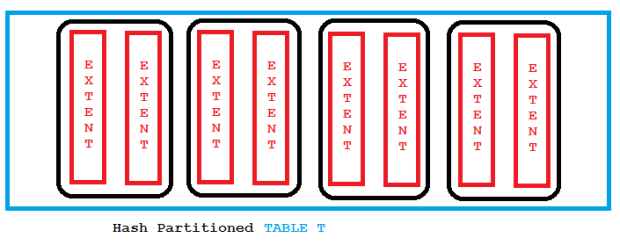
This emphasizes again that Partitioning is not only for the Data Warehouse. Hash Partitioning in particular can be used to fight contention in OLTP environments.
Pickleball spielen auf YouTube


 Pickleball spielen