The great success of my 11gR2 RAC Architecture picture encouraged me to publish this sketch that I have developed for an Exadata Storage Server Seminar LVC. In my opinion, a little visualization like that is helpful for many attendees to understand the relations of the various components easier. What do you think?

Addendum: The corporation kindly offered to translate my above amateurish sketch into a professional graphic which I gladly accepted. See the brushed up sketch below:
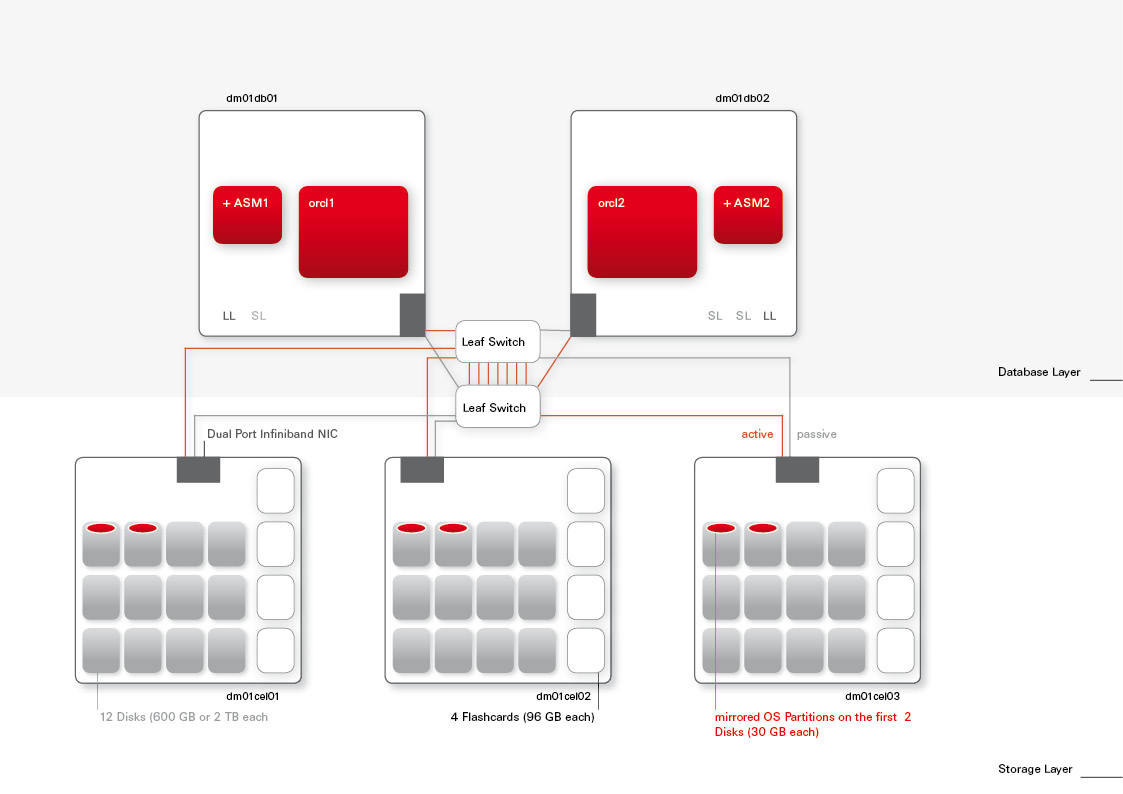 That does look really cool, doesn’t it? 🙂


 Pickleball spielen

#1 von Aman.... am Dezember 2, 2011 - 12:15
Wow, excellent Uwe and I am really thinking to make more „neat“ diagrams in my sessions too so that I can post them too 🙂 .
#2 von Amardeep Sidhu am Dezember 2, 2011 - 12:17
Cool…simple and informative !
Cheers !
#3 von Uwe Hesse am Dezember 2, 2011 - 12:19
Thank you, Aman! That is at least one advantage that computer scratches have upon using a real whiteboard: It is easier to post them. Well, and in my case, the writing is better readable too this way 🙂
#4 von nassyambasha am Dezember 2, 2011 - 12:26
Looks, Much difference in comparing with RAC on SAN & with Exadata. Can we find any more detailed description on architecture?
Thanks.
#5 von Uwe Hesse am Dezember 2, 2011 - 12:32
Amardeep: Thank you for the nice feedback!
nassyambasha: You may look at links list to the right, especially
http://www.oracle.com/technetwork/database/exadata/index.html
Also, on my dedicated Exadata page:
https://uhesse.wordpress.com/exadata/
There you will see amongst others an OU course that goes into much more details:
http://education.oracle.com/pls/web_prod-plq-dad/db_pages.getCourseDesc?dc=D73668GC10
#6 von Albert Spijkers am Dezember 3, 2011 - 14:25
Great picture and good resolution. Gives a nice schematic overview of the Exadata Architecture!
#7 von Dan am Dezember 15, 2011 - 14:54
Uwe, there’s the second version of the Exadata workshop, available here (LVC):
http://education.oracle.com/pls/web_prod-plq-dad/db_pages.getpage?page_id=232
Cheers,
Dan
#8 von Uwe Hesse am Dezember 15, 2011 - 15:43
Dan, thank you for the information. I have updated my Exadata page with the link to the new
(4 days) Workshop:
http://education.oracle.com/pls/web_prod-plq-dad/db_pages.getCourseDesc?dc=D73668GC10
#9 von Frederic am Dezember 19, 2011 - 06:49
Cool. Thanks Uwe
#10 von Ravi Swaminathan am Januar 18, 2012 - 04:20
Great picture , thanks very informative .
The dual port NIC cards on the DB nodes show one active one passive one active interface to
the leaf switches , these I believe for iDB calls to the storage cells , Is that right ?
Which ones are the private interconnect ?
TIA
#11 von Uwe Hesse am Januar 18, 2012 - 10:14
Thank you for the nice feedback 🙂
It may be surprising (because we always recommend against it in ordinary RAC configurations), but there is no PRIVATE interconnect on Exadata.
Instead, the Database Nodes use the same Network as Interconnect that is also used to connect to the storage servers. The Infiniband network is so fast that it is no problem in this case
#12 von Mohammed Alorainy am Juni 24, 2012 - 10:33
Thanks for the simple explanation. I wish you expanded that to:
1. how to upgrade to 1/2, full, & multiple RACs
2. how to connect the Exadata machine in the data center.
Thanks again that was good
#13 von Qingli Song (@QingliSong) am Juni 3, 2013 - 10:37
Hi Uwe,
ExadataViewer is a Exadata performance monitoring software. Thare is also a Exadata architecture diagram in Exadataviewer.
ExadataViewer can also help to observe smart scan offload statistics and physical I/O dataflow in a graphical view.
Would you please have a try and give your professional feedback.
Thanks.
#14 von Qingli Song (@QingliSong) am Juni 3, 2013 - 10:42
addition:
You can download ExadataViewer from http://www.exadataviewer.com
#15 von Uwe Hesse am Juni 13, 2013 - 10:10
Hi Qingli Song, apart from our Standard GUI Enterprise Manager that also has ways to monitor Exadata very comfortable, your tool looks quite interesting, but I presently just don’t have the time to have a closer look. Thank you for mentioning it here, though 🙂
#16 von A K am September 17, 2013 - 07:25
HI Qingli,
I have seen the demo of your tool. It’s seems very interesting. I am going to try it on my machine. 🙂
Thanks
http://exadatacertification.blogspot.com/
#17 von Wayne am November 26, 2014 - 21:11
Is the leaf switch the Infiniband switch?
#18 von Uwe Hesse am Dezember 3, 2014 - 09:55
Wayne, yes, we have two kinds of IB switches on Exadata. Leaf Switches like in the picture and Spine Switches that are being used to connect multiple Exadata racks over infiniband
#19 von Wneiton am April 5, 2015 - 14:34
Hi dear,
I have an Exadata X5-2 and I am new on it. How do my clients or my application servers communicate to Database nodes?
Do they do that through infiniband or ethernet network?
My question is if I need a cable from infiniband to my switch core ethernet.
Thank you.
#20 von Wneiton am April 7, 2015 - 14:37
Exadata X5-2 use the interface NET1 and NET2 or even the 4 NIC or the two 10 GbE for client and application network access.
Infiniband network is just to communication between Database nodes and Storage cells.
thanks
#21 von Uwe Hesse am April 29, 2015 - 15:36
Wneiton, thank you for the question and even more for the answer – I couldn’t make it before you answered it yourself 🙂
#22 von Bou Kal am November 15, 2015 - 10:57
infiniband network is just to communication between Database nodes and Storage cells.
Oon rac database 11g, we use to have two network interfacees : one for the public network interface and one for the private network interface (the interconnect)
as
http://www.idevelopment.info/data/Oracle/DBA_tips/Oracle11gRAC/CLUSTER_12.shtml#Network%20Configuration
Private network interface (the interconnect) needs to remain private, solely and exclusively for the use of the Cluster Interconnect.
See http://www.dba-oracle.com/t_rac_tuning_private_network.htm
Does exatada still use cache fussion if yes why are we putting on same interface as storage cells ?
#23 von Uwe Hesse am November 16, 2015 - 10:31
Is you first statement a question? Answer: No, it is also used for RAC node intercommunication, especially also Cache Fusion. On Exadata, we have a public network also, connected to the ethernet cards in the compute nodes. The ‚private network‘ on Exadata is for both, Storage Network and RAC node interconnect.
#24 von rajat sharma am Oktober 1, 2016 - 19:38
Hi Sir,
Could you please explain the connectivity between leaf switch?
how the storage cell and db node are connected together using these leaf switches?
#25 von VIJAY HINDURAO SHITOLE am September 11, 2017 - 05:31
Hi Sir,
Could you please explain the connectivity between leaf switch?
how the storage cell and db node are connected together using these leaf switches?